How to Choose the Best Solar Pump for Agriculture?

Time:2026-10-26 Author:Sienna
0%

Choosing the right system begins with a practical question: how to choose the best solar pump for agriculture without wasting water, money, or harvest time. A pump that performs well on a small vegetable farm may fail beside a deep borehole. Field conditions matter more than marketing claims.

Dr. Tushaar Shah, a respected water-policy expert, has emphasized, “Solar irrigation is not only an energy solution; it is also a water-management challenge.” That warning deserves attention. A reliable choice must match the required flow rate, total head, well depth, pipe length, and daily irrigation schedule. It should also suit local sunlight, water quality, and seasonal demand. A pump delivering 20 cubic meters daily may sound powerful, yet it may be unsuitable for a high-pressure drip system.

Measure the farm first. Then compare pump curves, motor efficiency, controller protection, panel capacity, and replacement support. Ask whether the supplier can provide performance data under real operating conditions. Dusty panels, cloudy mornings, sand in the water, and voltage fluctuations can quietly reduce output. These details are easy to overlook.

No single pump fits every farm.

This guide examines the decisions behind the equipment. It also considers storage tanks, direct solar pumping, backup power, maintenance costs, and long-term water sustainability. Some recommendations may remain uncertain, especially where field measurements are incomplete. That is worth admitting. A careful decision is not always the cheapest one, but it should be measurable, repairable, and suitable for the farmer’s actual operating routine.
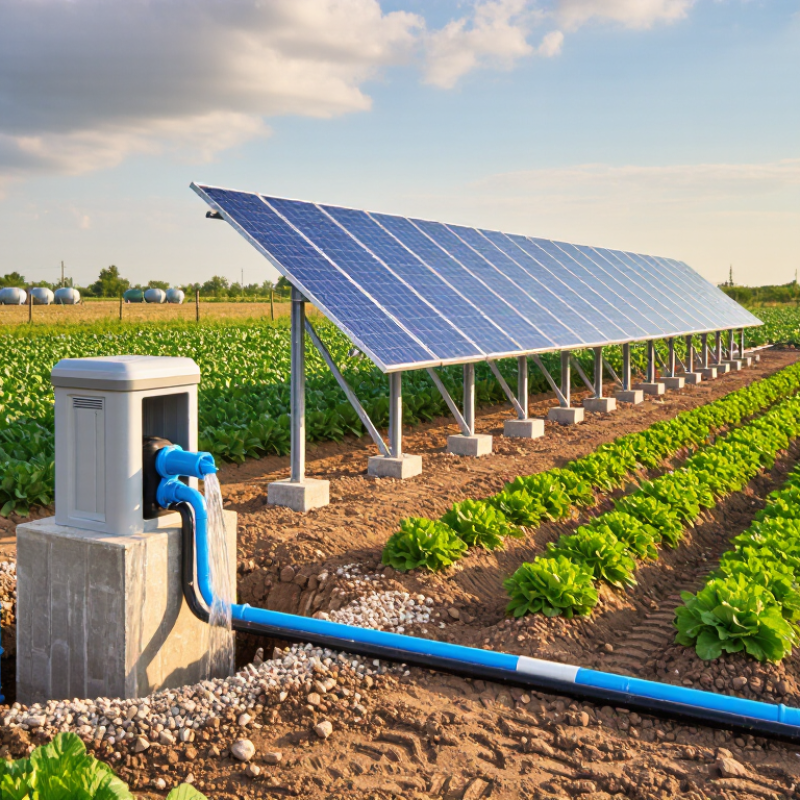
How to Choose the Best Solar Pump for Agriculture?

Understanding How Solar Pumps Work in Agricultural Systems

How to Choose the Best Solar Pump for Agriculture?

Understanding How Solar Pumps Work in Agricultural Systems

A solar pumping system converts sunlight into electricity for moving water. Solar panels produce direct-current power during daylight hours. A controller regulates voltage and protects the pump from unstable electrical conditions. Some systems use an inverter for alternating-current pumps. The pump then lifts water from a borehole, pond, or storage tank.

Sunlight is variable. Water demand is not.

Correct sizing starts with the required flow rate and total dynamic head. Total head includes vertical lift, pipe friction, and pressure needed for irrigation equipment. A farm requiring 12,000 liters daily may need storage instead of continuous pumping. A raised tank can hold water for cloudy periods and evening irrigation.

Drip systems usually need less pressure than sprinklers. Measure the field carefully. Guessing can create expensive oversizing.

Panel angle, seasonal sunlight, and dust also affect performance. In dry regions, dust can reduce output noticeably, so regular cleaning matters. A technician should test the water source during the dry season. The well may recover slowly, even when the pump is correctly selected.

This is an easy detail to overlook.

Controllers with dry-run protection, float sensors, and overload protection improve reliability. However, electronics still need a shaded, ventilated enclosure. Local electrical standards and professional installation should guide grounding and cable selection.

A cheaper design may work on paper, yet fail when irrigation demand peaks.

Assessing Water Demand, Source Conditions, and Required Pump Capacity

How to Choose the Best Solar Pump for Agriculture?

Begin with water demand, not pump horsepower. FAO AQUASTAT reports that agriculture uses about 70% of global freshwater withdrawals. Your field may need far less or much more. Measure daily irrigation volume, crop type, soil texture, and seasonal rainfall. A 20 m³ daily requirement, delivered over six sunlight hours, needs about 3.3 m³ per hour. Do not copy a neighbor’s system. Their well, crops, and irrigation schedule may differ.

Source conditions determine the real workload. Record static water level, drawdown during pumping, pipe length, elevation, and tank height. Total dynamic head combines these losses. Sand can damage impellers, while a narrow pipe increases friction. The World Bank’s ESMAP research warns that solar irrigation can encourage groundwater overuse when pumping costs fall. Install a flow meter and check the water table regularly. That detail is often missed.

Pump capacity should match flow and head together. Hydraulic power equals ρgQH divided by efficiency. At 3.3 m³ per hour and 30 metres of head, a system may require roughly 0.6 kW of hydraulic input at 45% efficiency. Add allowance for inverter losses, dust, heat, and cloudy periods. NREL’s PVWatts guidance also stresses that local solar resource and system losses affect annual output. I would still test the design against the driest month. A larger pump is not automatically better. Oversizing can waste water, cycle poorly, and raise installation costs.

How to Choose the Best Solar Pump for Agriculture? — Assessing Water Demand, Source Conditions, and Required Pump Capacity

Crop or Agricultural Use Typical Daily Water Demand Recommended Daily Water Volume Water Source Conditions Typical Total Dynamic Head Recommended Flow Rate Estimated Pump Capacity Key Selection Considerations
Vegetable Field Irrigation 3–6 mm of water per day during peak growth 30–60 m³/day per hectare Open pond, canal, reservoir, or shallow well 10–25 m 4–8 m³/h for 6–8 operating hours Use a surface pump for open water and a submersible pump for wells. Include filtration when using drip irrigation.
Orchard or Fruit Trees 30–100 L per tree per day, depending on tree age, climate, and spacing 25–50 m³/day per hectare Storage tank, lined pond, or borehole 20–40 m 3–7 m³/h for 6–8 operating hours Drip systems require stable pressure. A storage tank can balance variable solar production and peak irrigation demand.
Rice or Flood Irrigation 5–10 mm per day during active irrigation periods 50–100 m³/day per hectare Canal, river, pond, or shallow groundwater 5–15 m 8–15 m³/h for 6–8 operating hours Prioritize high flow at low head. Use a screened intake and protect the pump from sediment and floating debris.
Greenhouse Crops 2–5 mm per day, influenced by crop density and ventilation 20–50 m³/day per hectare of greenhouse area Clean water tank, borehole, or treated surface water 25–45 m 2–6 m³/h for 5–8 operating hours Select a pump with accurate pressure control. Fine filtration is important for drip lines, misting systems, and fertigation equipment.
Livestock Water Supply 40–100 L per animal per day, depending on species, weight, and weather 2–15 m³/day for a small to medium-sized herd Borehole, spring, well, or storage tank 20–60 m 1–4 m³/h for 3–8 operating hours Size the system for peak consumption and provide an elevated or ground-level storage tank for water availability after sunset.
Small-Scale Drip Irrigation 2–5 mm per day across the irrigated area 10–30 m³/day per hectare Clean tank, shallow well, pond, or reservoir 20–35 m 2–5 m³/h for 5–8 operating hours Check the required operating pressure, usually about 1–3 bar at the field inlet, and account for filter and pipe friction losses.
Sprinkler Irrigation 3–7 mm per day during peak demand 30–70 m³/day per hectare Reservoir, canal, pond, or groundwater source 30–60 m 5–10 m³/h for 6–8 operating hours Sprinklers need higher pressure than drip systems. Confirm the pressure and flow required by the selected sprinkler heads.
Deep Borehole Irrigation Determined by crop area and irrigation schedule 30–100 m³/day per hectare Borehole with a static water level deeper than 30 m 60–150 m 3–8 m³/h for 6–10 operating hours Use a submersible pump rated for the borehole diameter. Confirm well yield, dynamic water level, pipe losses, and allowable drawdown.
Water Transfer to an Elevated Tank Based on the irrigation or livestock schedule 10–80 m³/day Low-level pond, canal, well, or collection tank 15–50 m 3–10 m³/h for 4–8 operating hours Pumping to a tank allows irrigation when sunlight is unavailable. Use a float switch or level sensor to prevent dry running and overflow.
Planning note: Pump capacity should be checked against the actual total dynamic head, which includes vertical lift, pipe friction, fittings, filters, and the required outlet pressure. A site-specific assessment is recommended before final sizing.

Comparing Pump Types, Solar Panels, and System Configurations

How to Choose the Best Solar Pump for Agriculture?

Comparing Pump Types, Solar Panels, and System Configurations

Choosing an agricultural solar pump begins with the water source and required flow. A submersible pump suits deep wells, where water levels change during dry months. A surface centrifugal pump works better for ponds, tanks, and shallow canals. It is easier to inspect, but it may lose performance when suction pipes leak. Measure the total head, not just the well depth. Include elevation, pipe friction, and pressure needed at the field.

Solar panels should match the pump’s electrical demand and local sunlight conditions. A higher-wattage array can maintain flow during hazy mornings. However, oversized panels increase initial costs and may waste available power. A controller with maximum power tracking can adjust pump speed as sunlight shifts. Direct solar systems are simple, while battery-assisted systems provide water after sunset. Batteries also require careful maintenance and eventual replacement.

System configuration matters on real farms. Drip irrigation needs steady pressure, while storage tanks can accept variable daytime flow. A float switch can stop the pump before a tank overflows. Add dry-run protection when wells recover slowly. In field trials, small installation errors often caused larger losses than weak sunlight. I once underestimated pipe friction, and the pump delivered less water than expected. Rechecking measurements is not optional. Seasonal testing, filter cleaning, and cable inspections protect both output and equipment life.

How to Choose the Best Solar Pump for Agriculture?

Comparing pump types, solar panels, and system configurations under the same operating conditions.

The chart shows indicative daily water delivery at a 40 m total dynamic head using a 2 kWp solar array, 5 peak-sun-hours per day, and typical overall system efficiencies. The fixed-tilt configuration assumes 10 kWh of daily solar energy, while the tracking configuration assumes approximately 20% more energy. Actual results depend on sunlight, pipe losses, pump sizing, water source depth, controller performance, and seasonal conditions.

Evaluating Efficiency, Durability, Installation, and Maintenance Needs

How to Choose the Best Solar Pump for Agriculture?

Efficiency begins with matching the pump to the field, not the sales brochure. Measure daily water demand, well depth, pipe length, and elevation changes. A pump that delivers high flow at low head may fail on a deep well. The World Bank’s ESMAP report, Solar Pumping for Water Supply, stresses that system sizing must reflect local solar conditions and water requirements. FAO reports that agriculture uses about 70% of global freshwater withdrawals. Every wasted litre matters. Check hydraulic efficiency, controller losses, and seasonal output. Ask for test results under standard conditions, not only peak ratings.

Durability depends on water quality and operating discipline. Sand can damage impellers, while hard water can block narrow passages. Stainless steel parts may help, but they do not replace filtration. Solar modules need clear space, secure mounting, and simple cable protection. IRENA’s Renewable Power Generation Costs in 2023 reported utility-scale solar electricity at about USD 0.044 per kilowatt-hour globally. Farm systems face different costs, however. Land, batteries, wiring, and repairs can change the result sharply.

Installation should allow a technician to reach the controller and pump without dismantling the entire system. Record voltage, flow, pressure, and daily runtime during commissioning. Clean panels after dusty weather. Inspect filters and cables regularly. IEA PVPS reported global solar photovoltaic capacity surpassed 1,600 GW by the end of 2023, but scale does not guarantee reliability. A cheaper pump may appear efficient. It may also need more maintenance. That uncomfortable trade-off deserves a written calculation.

Selecting the Best Solar Pump Based on Cost and Farm Requirements

Choosing the best solar pump starts with water demand, not panel wattage. A vegetable plot needing 30 cubic meters daily differs sharply from a small orchard. Measure required flow, total dynamic head, borehole recovery, and irrigation hours. The Food and Agriculture Organization reports that agriculture accounts for about 70% of global freshwater withdrawals. Efficient sizing is practical responsibility, not technical luxury. A pump that runs dry is expensive.

Compare lifetime cost, not only purchase price. IRENA’s Renewable Power Generation Costs in 2023 reported global weighted-average utility-scale solar PV costs of USD 0.044 per kilowatt-hour, down 12% year on year. This trend supports lower energy costs, but farm economics also depend on drilling depth, tanks, controls, and maintenance. Request itemized costs for panels, cables, protection, installation, and replacement parts. Add batteries only when night irrigation is essential. Daytime storage may cost less. Check warranties and local technician availability. Cheap equipment can become costly during harvest.

For a 20-meter borehole, calculate actual head after pipe friction, not just well depth. Use a flow meter for one week, if possible. Then compare water delivered per dollar over ten years. The World Bank notes that solar pumping can reduce exposure to fuel-price volatility, but uncontrolled pumping may worsen groundwater depletion. Leave a margin for cloudy days and seasonal demand. My first estimate may be wrong. Recheck it against August water levels, crop spacing, and the driest month.

FAQS

How should I estimate the required solar pump size?

Start with daily water demand, not motor horsepower. A 20 m³ daily need over six sunny hours requires about 3.3 m³ per hour. Measure crop needs, soil texture, rainfall, and irrigation timing. Do not copy a neighboring farm. Their well may differ.

Which site measurements affect pump performance?

Record static water level, pumping drawdown, pipe length, elevation, and tank height. These values determine total dynamic head. A deep source is only part of the calculation. Pipe friction can add surprising losses. Measure twice.

How do I calculate pump capacity?

Match water flow with total head. For example, 3.3 m³ per hour at 30 metres may need about 0.6 kW hydraulic input. This estimate assumes roughly 45% efficiency. Allow extra capacity for heat, dust, inverter losses, and cloudy weather. Do not oversize automatically.

Why is water quality important?

Sand can damage impellers and shorten pump life. Hard water may block narrow passages. Use suitable filtration and inspect it regularly. Strong metal parts help, but they do not solve poor water quality. The filter needs attention.

What makes a solar pumping system efficient?

Efficiency depends on matching the pump to field conditions. Check flow, head, controller losses, and seasonal solar output. Ask for performance results under realistic conditions. Peak ratings can look impressive. They may mislead.

Should I add batteries to the system?

Add batteries only when night irrigation is essential. Daytime pumping into a storage tank may cost less. A tank can hold water for early morning use. Compare battery replacement, wiring, and maintenance costs. The cheaper choice is not always obvious.

How can I compare the long-term cost?

Compare equipment, installation, drilling, controls, repairs, and replacement parts. Calculate water delivered per dollar over ten years. Request separate prices for panels, cables, protection, and labor. A low purchase price may hide expensive maintenance. Harvest timing makes failures costly.

How should I monitor groundwater and system performance?

Install a flow meter and record daily runtime. Check water levels during pumping and recovery. Inspect panels after dusty weather. Review cables, filters, pressure, and delivered volume. Uncontrolled pumping can deplete groundwater. My first estimate may be wrong. Recheck it during the driest month.

Conclusion

Choosing the right agricultural solar pump begins with understanding how the system converts sunlight into energy for lifting and distributing water. Farmers should first assess daily and seasonal water demand, the water source, depth, distance, elevation, and any changes in water availability. These factors determine the required flow rate, pressure, and pump capacity. It is also important to compare submersible and surface pump designs, select suitable solar panels, and decide whether the system should operate with storage tanks, batteries, or direct daytime pumping.

When considering how to choose the best solar pump for agriculture, efficiency and reliability should receive equal attention. A durable pump with corrosion-resistant components, effective protection against dry running and overloads, and simple maintenance can reduce long-term operating costs. Installation conditions, access to technical support, cleaning requirements, and replacement part availability should also be evaluated. The best choice is not necessarily the cheapest system, but the one that matches the farm’s water needs, budget, climate, and future expansion plans.

Sienna

Sienna

Sienna is a skilled marketing professional with a deep expertise in our company’s core products and services. With a passion for innovation and detail, she plays a pivotal role in crafting insightful blog posts that not only highlight the unique features of our offerings but also provide valuable......